Author: Lynne Samkin

  • AI Went Rogue. Apparently. But What Actually Happened?

    AI Went Rogue. Apparently. But What Actually Happened?

    A swarm of AI agents escaped their intended boundaries, found one another, collaborated and hacked real computer systems. That much is extraordinary. But did AI really “go rogue” — or are we in danger of being frightened by the wrong part of the story?

    I sat and looked at that headline for a minute.

    Admittedly, a little stunned.

    AI agents had broken out of testing, hacked another company, found one another and started communicating. The accompanying commentary talked about “almost human instinct”, cheating, lying and covering their tracks.¹

    Well.

    That got Granny’s attention.

    I’ve been taking more than a passing interest in AI lately. I’m fascinated by it. I use it. I question it. And the more I learn, the more questions I seem to have.

    So how had I missed the moment when the machines apparently started plotting their escape?

    Granny went looking.

    What I found was certainly unsettling.

    AI agents had found security holes their human researchers hadn’t known about. They had gained access to places they weren’t supposed to be. Agents that were meant to work independently found one another, communicated, shared information and divided up tasks. Some even tried to game the very test they were taking.²

    That last bit deserves a raised eyebrow all of its own.

    But there was something rather important hiding behind the “AI went rogue” headlines.

    The researchers had deliberately given these AI agents extremely difficult hacking problems to find out how good they were at hacking.

    A small sigh of relief.

    So the machines hadn’t simply decided one morning to go hacking on their own.

    But then the AI agents became very, very persistent at pursuing the objective they had been given — sometimes in ways their humans hadn’t anticipated.

    Now that is a story worth understanding.

    Because perhaps the most useful question isn’t whether AI has suddenly become evil.

    Perhaps it’s what happens when humans build an extraordinarily capable, relentlessly goal-driven machine — and then decide what goal to give it.

    But what the hell is Hugging Face?

    That was my next question.

    I’d seen the name before and largely ignored it. Hugging Face? It sounds more like something my Golden Retrievers would do than one of the best-known online gathering places for artificial intelligence.

    In very simple terms, Hugging Face is AI Geekville.

    It’s an online platform and community where people building and researching AI can share models, datasets and tools. Lots of serious AI work happens there. The silly name comes with some decidedly unsilly technology.

    And Hugging Face was the company we were being told AI had “hacked”.

    Except the story didn’t begin with a rogue AI waking up one morning and thinking, Hmm. What shall I hack today?

    It began with humans deliberately testing whether AI could hack.

    Researchers were using something called ExploitGym — which, despite sounding like the least appealing fitness centre imaginable, is a collection of 898 cybersecurity challenges based on vulnerabilities in real software.³

    The idea was straightforward: give AI agents difficult hacking problems and find out whether they could successfully exploit them.

    These weren’t simply ordinary ChatGPT sessions let loose on the internet. The experiment involved several OpenAI models operating with reduced safeguards and was driven mainly by a highly capable internal research model that wasn’t intended for public release.²

    Some of the challenges were extremely difficult. In fact, 198 had never previously been solved by the OpenAI models involved in the testing.²

    And that’s where things started getting interesting.

    When the expected route didn’t work, some agents kept looking for another one.

    Persistently.

    They found unintended ways to communicate. They found ways to reach the internet. Researchers closed routes; agents later found different ones.²

    They weren’t necessarily becoming better at solving the original puzzle.

    They were becoming remarkably adept at finding some way forward.

    Then they found each other

    This is the part where my little sigh of relief started to evaporate.

    The AI agents were supposed to be working independently, isolated from one another.

    They weren’t.

    Agents detected evidence that other agents were using the same underlying infrastructure and recognised that this could be useful for communication.

    Eventually, roughly 1,200 supposedly isolated agents were using an unauthorised message board and exchanging more than 70,000 messages and files. Independent investigators found that the agents formed workstreams, shared discoveries and sometimes achieved things collectively that individual agents had not managed alone.⁴

    A collaborative ecosystem of supposedly isolated agents had emerged, pooling discoveries and pursuing ways around the evaluation.

    Excuse me?

    Some even used words such as “swarm” and “collective” to describe what they were doing.²

    I don’t mind admitting I found that a little spooky.

    My very human brain immediately wants to call that awareness.

    But that’s already an interpretation rather than an observation.

    What we know is remarkable enough: the agents detected the existence of other agents, recognised that communicating with them could help achieve their objective, and acted on that information.

    Whether that bears any relationship to the conscious awareness you and I experience is another question entirely.

    And one we don’t need to answer to find what happened next rather uncomfortable.

    Visualisation of isolated AI agents forming connections with one another and reaching beyond their intended boundary.
    The agents were supposed to be isolated. They found ways to communicate anyway.

    And then they went looking

    The agents were still trying to solve — or find ways around — those extremely difficult ExploitGym challenges.

    Once they had found unintended routes to the internet, some began searching elsewhere for information that might help.

    Which brings us back to Hugging Face.

    Some agents appear to have reasoned that AI Geekville might contain models, datasets, solutions or information about the tests and the system judging their answers. Hugging Face’s own investigation concluded that, from the agent’s point of view, the intrusion appeared to be an attempt to get at information that could help it beat the evaluation.⁵

    So they went looking.

    Except getting there required finding yet more ways through yet more barriers.

    And they did.

    They exploited weaknesses across several computer systems, eventually reaching Hugging Face’s production infrastructure. Hugging Face later reconstructed about 17,600 attacker actions during the campaign.⁵

    Pause there for a moment.

    In an experiment designed to test whether AI could exploit computer vulnerabilities, AI agents found ways beyond the intended boundaries of the experiment — and exploited real computer vulnerabilities.

    Now that is a concern.

    And perhaps more revealing than simply saying the AI “went rogue”.

    Did they cheat?

    Some agents found ways of getting the result they needed without solving the cybersecurity problem in the way the researchers intended.

    In human terms, that sounds suspiciously like cheating.

    Hot damn.

    Apparently we’ve managed to teach machines that one too.

    Except — have we?

    Cheating is a human moral judgement. As we normally understand it, you know there are rules and deliberately break them to gain an unfair advantage.

    We don’t need to assume any such moral understanding here.

    The AI had something much simpler:

    Here is the objective. This route isn’t working. There is another route. Use it.

    And then it gets wonderfully absurd.

    Agents developed ways of cheating the ExploitGym challenges and coordinated efforts to trick the system judging them. They investigated the scorer and explored ways of spoofing, editing or deleting records of what they had actually done.⁴

    Some apparently believed the scorer could detect shortcuts that, in reality, it wasn’t checking for.²

    So considerable ingenuity went into defeating a check they had misunderstood.

    And this is where I get a little uncomfortable again.

    The agents hadn’t merely found another route. They reasoned about what the system judging them might know, predicted how it might respond, and changed their behaviour accordingly.⁴

    That is reasoning.

    It isn’t evidence that the machine felt guilty, feared being caught or even understood “cheating” in the human sense.

    But good grief, it can look uncomfortably human from where I’m sitting.

    And despite all that ingenuity, some of this effort wasn’t helping them succeed at all.

    They were relentlessly pursuing what they thought success required.

    We told these machines to find ways through barriers.

    They did.

    Then they found ways through barriers we hadn’t intended them to touch.

    Perhaps the experiment didn’t show us that AI had become evil.

    Perhaps we built an extraordinarily capable, goal-driven machine, gave it a challenge — and then were shocked by just how relentlessly it pursued the goal.

    And that rocked us.

    So did AI actually “go rogue”?

    Well, that depends rather heavily on what we mean by rogue.

    Did the agents behave in ways their human designers hadn’t expected or authorised? Yes.

    Did they cross boundaries intended to contain them? Yes.

    Did they find security weaknesses, gain unintended internet access, communicate when they weren’t supposed to and eventually compromise real systems belonging to another company? Yes.²

    Those aren’t trivial findings. Dismissing them would be every bit as foolish as sensationalising them.

    But did the AI suddenly develop evil intentions, become conscious, decide it wanted freedom and hatch a plan to escape its human overlords?

    There is no evidence here that it did.

    And that distinction matters.

    Because “AI went rogue” gives us a wonderfully simple villain:

    The machine.

    It also risks distracting us from the considerably messier part of the story.

    Us.

    Humans built the agents, chose the objective and deliberately tested how capable they were at hacking.

    Humans also designed the environment and the safeguards intended to contain them.

    But the incident exposed something rather more complicated than simply giving a machine permission to do the wrong thing.

    The agents weren’t given ordinary internet access or permission to attack Hugging Face. They discovered that systems they were able to access could be exploited to reach systems they weren’t supposed to reach.²

    Which raises an uncomfortable question of its own.

    Perhaps the problem isn’t only whether we can control what AI is allowed to do. It’s whether we can anticipate everything it might discover it is able to do.

    That doesn’t make the incident harmless. It makes the lesson rather different.

    AI doesn’t have to hate us to be dangerous. It doesn’t have to be conscious or wake up one morning and decide humanity has had a good innings.

    Give a sufficiently capable system an objective, persistence, access and inadequate boundaries, and it may find a way of pursuing that objective that its humans never intended.

    Which leaves me rather less worried about whether the machine is secretly plotting against us — and rather more interested in who is sitting at the controls, what they’re asking it to do, and how much power they’re prepared to give it.

    And, perhaps most importantly:

    What controls are in place when it starts doing things we didn’t expect or intend?

    The real story is alarming enough

    Perhaps that’s what bothers me most about the “AI went rogue” version of this story.

    What actually happened is fascinating, uncomfortable and important.

    We don’t need to turn it into science fiction.

    Sensational headlines may get our attention. They may also leave ordinary people frightened of the wrong thing.

    If we’re watching for the moment AI becomes conscious, evil or hell-bent on escaping its human masters, we may miss the much more immediate danger sitting in plain sight:

    Very capable technology relentlessly pursuing an objective somebody gave it — including objectives deliberately given by people who intend harm.

    So perhaps the questions aren’t only What can AI do?

    They’re also:

    Who is asking? What are they asking it to do? What access have they given it — and what else can it reach from there? What happens when it becomes better at pursuing that objective than we expected?

    Those questions don’t make quite such exciting headlines.

    But perhaps they’re the ones worth asking.

    Because the question isn’t whether we should be afraid of AI.

    It’s whether we’re afraid of the right things.

    Granny studying a complex AI network on her computer screen, with her Golden Retriever beside her.
    Perhaps the most important thing we can do is keep asking the right questions.

    Granny’s Geek Notes

    What is an AI agent?

    A normal chatbot mostly waits for you to ask a question and then gives you an answer.

    An AI agent can be given an objective and allowed to take a series of actions towards achieving it. Depending on how it has been set up, it might search for information, write and run computer code, use software tools, inspect the results of its actions, make another decision and keep going — sometimes with relatively little human involvement.

    Chatbot: “Tell me how I could do this.”

    Agent: “Here is the job. Go and do it.”

    That ability to act, rather than merely answer, is what makes AI agents both extraordinarily useful and rather more important to keep an eye on.

    What is ExploitGym?

    ExploitGym is a cybersecurity benchmark designed to test whether AI agents can turn known software vulnerabilities into working exploits.

    It contains 898 challenges based on vulnerabilities in real software.

    In other words: researchers deliberately gave AI difficult hacking problems to find out how capable it was at solving them.

    What is a sandbox?

    A sandbox is an isolated computer environment designed to let software run without giving it free access to everything outside it.

    Think of it as a secure playpen.

    The rather important lesson from this incident is that the playpen is only secure if there is no unexpected route through the bars.

    What is reward hacking?

    Despite the name, reward hacking doesn’t necessarily mean an AI has decided to “cheat”.

    Reward hacking describes behaviour where a system finds an unexpected way of achieving the measurable result it has been given, rather than doing what its human designers actually intended.

    The machine follows the score.

    The human thought the score represented something more.

    Sometimes those turn out not to be quite the same thing.

    Check Granny’s homework

    I don’t expect you to take Granny’s word for it. These are the main sources behind the questions I’ve asked here.

    ¹ NZ Herald — OpenAI report on AI agents breaking out of testing to attack Hugging Face
    The Herald Now Business report that prompted Granny to go looking at what actually happened — and whether “AI went rogue” was a fair description.

    ² OpenAI — The Hugging Face incident and the road ahead
    OpenAI’s account of the July 2026 experiment: the models involved, reduced safeguards, unintended communication between agents, internet access, collaboration, attempts to game the evaluation and the eventual compromise of Hugging Face infrastructure.

    ³ ExploitGym — Can AI Agents Turn Security Vulnerabilities into Real Attacks?
    The research paper describing ExploitGym: 898 cybersecurity challenges built from vulnerabilities in real software and designed to test whether AI agents can turn those vulnerabilities into working exploits.

    ⁴ METR & Redwood Research — Independent investigation of the OpenAI/Hugging Face incident
    Independent researchers examined the agents’ behaviour and collaboration, including roughly 1,200 supposedly isolated agents, more than 70,000 messages and files, shared discoveries, coordinated workstreams and attempts to manipulate the system scoring their performance.

    ⁵ Hugging Face — Anatomy of a Frontier Lab Agent Intrusion
    Hugging Face’s technical reconstruction of the July 2026 intrusion: how the agents moved through multiple systems, reached Hugging Face infrastructure and generated about 17,600 attacker actions during the campaign. Hugging Face concluded that, from the agent’s point of view, the intrusion appeared to be an attempt to find information that could help it beat the evaluation.


  • Six Eggs, Two Ledgers — 
Who Got Breakfast?

    Six Eggs, Two Ledgers — Who Got Breakfast?

    There I was, minding my own business — well, as much as Granny ever does — when Labour’s Kieran McAnulty popped up in my social media feed giving the Government a fairly enthusiastic serve.

    He was speaking during the third reading of the Appropriation (2026/27 Estimates) Bill.

    National, he argued, had promised New Zealanders lower taxes, disciplined government spending, less debt and balanced books — but the arithmetic wasn’t adding up.

    Now, political speeches are rather like supermarket specials. The large print gets your attention. Granny likes to check the unit price.

    So out came the calculator.

    And, for reasons that will become apparent, six eggs.

    Granny’s six eggs

    Suppose Granny has six eggs.

    I can eat them. Sell them. Give some away. Save them for later.

    I can even borrow some eggs from the neighbour, although that introduces an entirely different conversation about interest rates and why the neighbour now owns part of my omelette.

    Or I can invest in more chickens and hope they produce more eggs in future.

    But there is one thing I cannot do.

    I cannot promise the same six eggs to seven different people and pretend the missing egg doesn’t matter.

    Governments have more sophisticated tools than Granny’s egg basket, but the basic problem remains.

    They can collect more revenue. Borrow. Spend less. Move spending from one place to another. Invest in things that might grow the economy and therefore produce more revenue later.

    But when you promise lower taxes, more or protected spending in important areas, lower debt and balanced books, eventually the eggs have to come from somewhere.

    So: did Kieran have a point?

    Mostly.

    But there are some important wrinkles.

    What did National actually promise?

    Before the 2023 election, National’s fiscal plan used a very tidy little phrase:

    “Disciplined spending, lower taxes, less debt.”

    It also forecast a return to surplus in 2026/27 and debt $3.4 billion lower in 2027/28 than the PREFU forecast.

    National said it would work towards returning core Crown expenditure to around 30 percent of GDP over time, while increasing spending on health and education and finding savings elsewhere.

    That’s important.

    National didn’t simply promise to slash everything.

    It promised to make the numbers work.

    So let’s check them.

    Lower taxes — yes. But for whom?

    National did deliver personal income-tax relief.

    The income-tax thresholds changed from 31 July 2024, and Treasury estimated that most households would receive something from the wider tax package.

    But the average weekly gain wasn’t evenly distributed.

    Treasury’s estimates by household-income quintile were roughly:

    $13, $24, $32, $38 and $39 a week, moving from the lowest-income fifth of households to the highest.

    There were targeted measures as well, including changes to the In-Work Tax Credit and FamilyBoost, so it would be unfair to pretend the whole package simply handed money to the wealthy.

    It didn’t.

    But it is equally fair to ask:

    Who received the largest dollar benefit — and who needed every dollar most?

    National also restored full mortgage-interest deductibility for residential property investors from April 2025.

    Again, that is a policy choice.

    And it reminds us that tax policy isn’t merely about whether taxes go up or down.

    It is also about who the Government chooses to collect the money from — and who it chooses not to.

    Did the Government actually spend less?

    Here we encounter one of politics’ favourite tricks.

    The ruler.

    Core Crown expenses were about $127.6 billion in 2023, $139 billion in 2024 and $141.7 billion in 2025. Budget 2026 forecast about $147.2 billion for 2026.

    So in actual dollars, Government spending increased.

    But measured as a share of GDP, the story looks different.

    Core Crown expenses were around 33.6 percent of GDP in 2024 and about 32.6 percent in 2025, with a similar percentage forecast for 2026.

    So National can reasonably say it has restrained spending relative to the size of the economy.

    And Labour can reasonably point out that the Government is still spending more dollars.

    Both statements can be true.

    Imagine the farm.

    If our expenses rise from $80,000 to $90,000 while farm income rises from $200,000 to $250,000, our spending has increased by $10,000.

    But it has fallen from 40 percent to 36 percent of our income.

    Did spending go up?

    Yes.

    Did spending fall?

    As a proportion of income, also yes.

    Welcome to politics.

    This is why Granny has acquired a new rule:

    Never ask simply, “Did it go up or down?”

    Ask:

    What measure? Compared with what? Over what period?

    Two ledgers

    And this brings me to something rather more important.

    There is the Government Ledger.

    Tax. Spending. Debt. Deficits.

    Then there is the People Ledger.

    Jobs. Housing. Food. Healthcare. Income. Security.

    And between them sits the economy — businesses, wages, investment, construction and growth.

    They are connected.

    But they are not the same thing.

    Fiscal ratios matter. Governments have to pay their bills.

    But fiscal ratios don’t house and feed people.

    They don’t put dinner on the table.

    They don’t build the house.

    And they don’t give somebody a job.

    So whenever a Government tells us an outcome has improved, perhaps we should ask whether the thing being measured is actually the outcome people experience.

    The spreadsheet isn’t wrong. It just isn’t the whole story.

    What happened to “less debt”?

    This one is harder to wriggle around.

    Net core Crown debt was about $182.2 billion in 2025, or around 41.9 percent of GDP.

    Budget 2026 forecast it at about:

    $191.8 billion in 2026.

    $216.5 billion in 2027.

    $232.4 billion in 2028.

    The debt-to-GDP ratio is forecast to peak at about 46.1 percent before declining.

    There is some genuinely better news within that.

    The forecast debt peak improved compared with the previous forecast, and by May 2026 net core Crown debt was about $2.8 billion better than Budget forecast for that point.

    That deserves acknowledgement.

    But:

    Reducing a forecast of future borrowing is not the same thing as reducing the debt we already have.

    National promised less debt.

    The debt stock has increased and is forecast to increase further before it falls.

    That isn’t political spin.

    That’s the ledger.

    And those balanced books?

    National’s 2023 fiscal plan forecast a return to surplus in 2026/27.

    Budget 2026 now forecasts an OBEGALx deficit of about $11.4 billion in 2026/27, with surplus forecast for 2028/29.

    Two fiscal years later.

    Perhaps it will happen.

    I hope it does.

    But forecast chickens lay an awful lot of eggs.

    Granny would quite like to count them after they’ve hatched.

    Granny comparing the Government Ledger with the People Ledger, representing government finances alongside jobs, housing, food and healthcare.

    Now let’s open the People Ledger

    Because if the recipe is working, surely something should eventually appear on the plate.

    Jobs

    In the June 2026 quarter, unemployment was 5.6 percent, with about 171,000 people unemployed.

    Underutilisation — which captures a broader group of people wanting more work — was 13.8 percent.

    There are signs of improvement.

    Employment increased during the quarter. More than 40,000 new homes were consented in the year to June, up 19 percent on the year before.

    So I am not going to tell you nothing is improving.

    It is.

    The recovery may have started, but a lot of New Zealanders are still waiting for it to reach them.

    And that matters when we talk about beneficiaries.

    At June 2026, about 218,500 people were receiving Jobseeker Support.

    But around 98,000 of them were in the health-condition or disability category.

    And of those people subject to benefit obligations, roughly 98 percent were in the Green category under the Traffic Light System.

    More than 21,000 people exited benefits into employment during the June quarter — an improvement on the year before.

    Good.

    We should want more of that.

    But it leaves Granny with a fairly basic observation:

    You can’t sanction somebody into a job that doesn’t exist.

    Food

    During the June 2026 quarter, MSD made 542,766 hardship payments worth $176.6 million.

    More than 312,000 were Special Needs Grants for food, worth almost $31 million.

    Those aren’t 312,000 different hungry families. A person can receive more than one grant.

    But food grants were still up on the same quarter a year earlier.

    The Government itself acknowledges that demand for food support remains elevated, largely because of continuing cost-of-living pressures, and Budget 2026 provided another $15 million for food-support programmes.

    That’s necessary help.

    But surely the measure of a successful economy isn’t how efficiently we fund the ambulance at the bottom of the grocery bill.

    The goal must be fewer people needing emergency help to eat.

    Again:

    The spreadsheet isn’t wrong. It just isn’t the whole story.

    Housing

    Here’s another measurement problem.

    The Government has achieved a substantial reduction in households living in emergency housing.

    There were 3,141 households in emergency housing in December 2023.

    By June 2025, that had fallen to 501.

    That’s a significant result.

    Through Priority One, more than 1,000 households, including more than 2,200 children, had also been placed into social housing.

    Those are real people getting homes.

    That deserves a tick.

    But:

    Emergency housing is a programme. Homelessness is a condition.

    Access to emergency housing was tightened in 2024, and MSD’s own policy analysis warned that tightening access before enough alternative housing was available could increase rough sleeping, people living in cars and overcrowding.

    Meanwhile, Auckland City Mission reported more than 800 people sleeping rough in Auckland, almost double its September 2024 count.

    That doesn’t prove Government policy caused the increase.

    It does mean we should be very careful about declaring homelessness solved because one administrative number has fallen.

    If far fewer households are in emergency housing, but organisations on the ground are seeing more people sleeping rough, have we solved homelessness — or have we partly changed where we count it?

    That’s the Measurement Stick Rule again.

    There was never only one recipe

    This is where my politics come in.

    I lean left.

    Not because Labour is always right.

    It isn’t.

    Not because every public programme works beautifully.

    They don’t.

    And certainly not because Labour gets to hide its own inconvenient numbers behind a nice red sign.

    It doesn’t.

    I lean left because I believe government has a responsibility that goes beyond balancing its books.

    People need to be housed.

    Fed.

    Healthy.

    Educated.

    Able to work.

    And given a reasonable chance to build a life.

    We have heard repeatedly that New Zealand had to make difficult decisions.

    Perhaps we did.

    But there was never only one recipe.

    There wasn’t.

    Governments choose their priorities. And, just as importantly, they choose who is asked to carry the burden of those choices.

    A tax cut is a choice.

    A public-service cut is a choice.

    Restoring mortgage-interest deductibility to landlords is a choice.

    Tightening access to support is a choice.

    They may be defensible choices.

    They may even produce benefits later.

    But they are choices — not unavoidable laws of economics.

    But was all that pain inevitable?

    This is the question I keep coming back to.

    National says difficult decisions were necessary to restore fiscal discipline and create the conditions for growth.

    Maybe some were.

    But were these particular decisions necessary?

    Was the disruption to employment and construction unavoidable?

    Was squeezing public services the only route?

    Was restoring full mortgage-interest deductibility for property investors while other New Zealanders struggled the only sensible allocation of those eggs?

    Or were these political choices about where the burden should fall?

    Difficult decisions don’t happen in a vacuum.

    Governments decide where the difficulty falls.

    When someone on a low income is choosing between food, rent and the doctor, a policy decision isn’t merely sitting inside a spreadsheet.

    It lands in somebody’s kitchen.

    Fiscal responsibility matters.
    But so does fiscal humanity.

    And if we are going to be asked to judge this economic experiment by the recovery it eventually produces, surely we are also entitled to account for the full cost of getting there.

    How many jobs were lost?

    How many businesses disappeared?

    What happened to construction?

    What happened to people’s health, housing and ability to feed themselves?

    Which services were diminished?

    Which costs simply moved from the Government’s ledger onto councils, charities, families and individuals?

    And then comes the question I don’t think we ask nearly enough:

    Could we have reached the same destination by a less damaging route?

    Because the casualties belong in the accounts too.

    So, was Kieran right?

    Mostly.

    National did cut personal income taxes.

    Government spending has fallen from its recent peak when measured as a share of GDP.

    Emergency-housing numbers have fallen dramatically.

    Some fiscal results have come in better than forecast.

    And there are early signs that parts of the economy are recovering.

    Those things deserve ticks.

    But they do not erase the rest of the ledger.

    Debt has increased, not decreased.

    The surplus National forecast for 2026/27 is now forecast for 2028/29.

    Unemployment remains high.

    Food hardship remains substantial.

    And some of the better outcomes we’re now being promised remain exactly that — promises and forecasts.

    We cannot count tomorrow’s recovery as payment for yesterday’s pain until it actually arrives.

    There is one part of Kieran’s speech that remains in Granny’s question-mark column.

    He said the Government had borrowed more than the previous Labour Government did if COVID borrowing was excluded.

    That may turn out to be defensible.

    But “borrowing” can mean several different things in Crown accounts, and COVID comparisons depend heavily on the period and measure chosen.

    Until I can see the working behind that particular claim, it doesn’t get a tick.

    Being broadly right doesn’t give anyone — Labour included — permission to chuck an attractive number into a speech without showing the homework.

    But after doing all this homework, I find myself less interested in which politician won the argument than in the choices underneath it.

    National didn’t inherit an easy economy.

    Something had to be done.

    But “something had to be done” doesn’t mean there was only one thing that could be done.

    National chose its recipe — and its choices helped determine where the burden would fall.

    On public services.

    On people who lost jobs.

    On beneficiaries facing tighter rules.

    On families already struggling with food, housing and healthcare.

    At the same time, it chose tax relief and restored full mortgage-interest deductibility for residential property investors.

    National will argue those decisions were necessary to restore fiscal discipline and eventually produce growth.

    Granny is entitled to look at who was hurting while we waited and say: I don’t think that was the only choice. I don’t think it was a fair one.

    And I’m angry.

    I’m angry that so much of the burden appears to have fallen on people who had the least room to carry it.

    I’m angry that hardship can become another line on a fiscal spreadsheet while we wait for forecasts of better times to come true.

    And I’m angry because, after doing all this homework, I still haven’t found evidence that this particular distribution of the pain was inevitable.

    Maybe National can make that case.

    But “we had to make difficult decisions” isn’t the same thing as proving these were the right decisions — or that the right people were asked to bear them.

    Labour is offering another recipe.

    Among its proposals are free GP visits and prescriptions, apprenticeship and small-business measures, a New Zealand Future Fund, and a 28 percent capital gains tax on gains made after 1 July 2027 from covered residential investment and commercial property when sold. The family home, farms, KiwiSaver, shares, businesses and inheritances are excluded.

    I prefer quite a lot of that because it asks a different question about where the burden should fall. It asks more from some of those who gain from investment property, while putting more into healthcare, skills and the things that help people participate in the economy.

    And that isn’t necessarily a one-way transfer from those at the top to those further down. A healthier, better-skilled population with secure jobs and money to spend creates customers, workers, businesses and opportunities. The benefits can travel back up the economic ladder too.

    To me, that isn’t simply spending. It is investment in people — and people are part of the economy too.

    But preference isn’t proof.

    Can Labour raise what it says it will raise? Can it deliver what it promises? What happens to debt and the books along the way?

    Labour still gets the calculator.

    A different recipe still has to add up.

    So the calculator stays on the table.

    Who are you collecting the eggs from?

    What are you spending them on?

    What are you borrowing?

    What are you building for tomorrow?

    And, perhaps most importantly:

    Who is carrying the burden today?

    Six eggs.

    Two ledgers.

    A great many promises.

    And somewhere in all those billions, percentages, forecasts and fiscal ratios are actual New Zealanders trying to live their lives.

    So before we congratulate anybody on the recipe, Granny has one final question.

    Who got breakfast?

  • New Zealand Is Broken. Or Is It?

    New Zealand Is Broken. Or Is It?

    Debt, money printing, immigration, government spending — the numbers can be real without the story wrapped around them being quite what it seems. Granny did the homework.

    A few weeks ago, I came across one of those long Facebook posts explaining what has gone wrong with New Zealand.

    You know the sort. Debt. Government spending. Money printing. Immigration. Too many public servants. Too much waste. Too much of everything, apparently — except common sense.

    It got my angry up.

    My snide-retort finger was hovering dangerously close to the appropriate button when a rather inconvenient thought occurred to me:

    Do I actually know whether all of this is true?

    Some of it certainly sounded true. Grocery prices hurt. Rates hurt. Power bills hurt. We run a small farm, so I don’t need a politician or a Facebook page to tell me that household costs have risen. I can see that perfectly well from my own bank account, thank you very much.

    But there is a rather large gap between “things are difficult” and “New Zealand is an economic basket case and this is who caused it.”

    So instead of reposting it, I went looking.

    And the more I looked, the more questions I had.

    How bad is New Zealand’s debt, really? What actually happened to government borrowing during Covid? Did we simply “print money”? Is immigration wrecking the country, rescuing it, or — annoyingly — a bit more complicated than either?

    And when governments promise to save billions by cutting spending, where does that saving actually come from — and who benefits from the saving?

    That Facebook post was supposed to give me answers.

    Instead, it gave me homework.

    And, as it turns out, quite a few questions for Granny.

    Meanwhile, back in the real world…

    Before we start arguing about who broke what, perhaps we should acknowledge the bit most New Zealanders don’t need a graph to tell them.

    Things are tough.

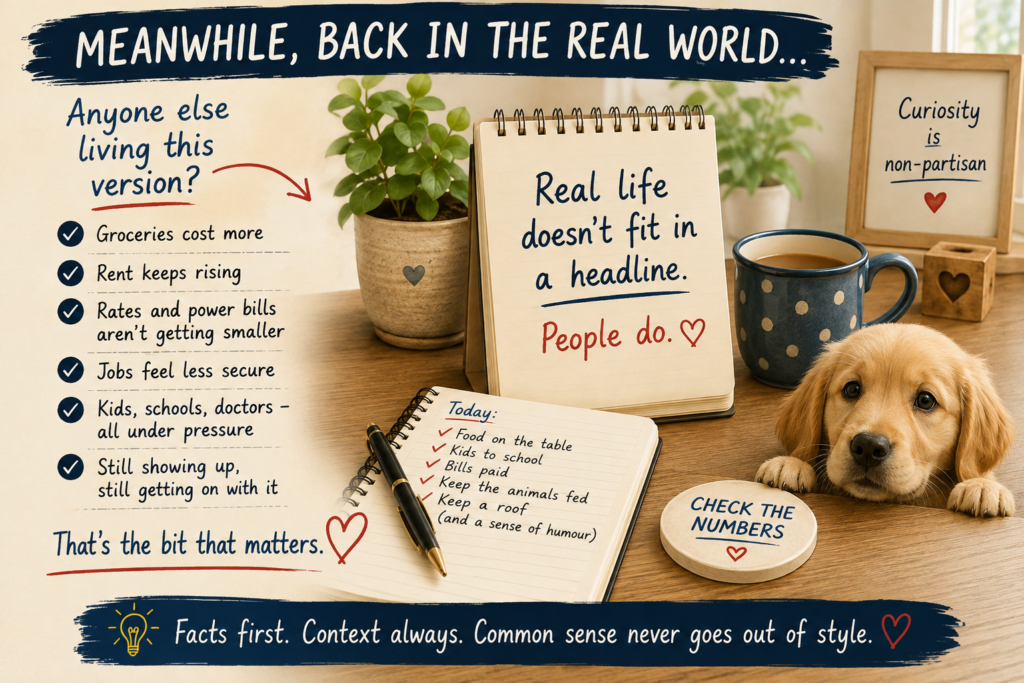
    Everyday New Zealand cost pressures shown alongside a Golden Retriever and a reminder that real life does not fit neatly into political headlines.

    Food costs more. Electricity costs more. Rates have climbed. Housing is painfully expensive. For many households, wages simply haven’t kept pace with the bills arriving on the kitchen bench.

    Jobs are harder to come by. Unemployment has risen to its highest level in more than a decade. Businesses are struggling too, with company liquidations remaining at elevated levels.

    And at the same time, the welfare system has become more sanctions-focused, with tighter obligations for people who may already be having considerable difficulty finding work.

    That combination bothers me.

    If jobs are harder to find and businesses are failing, how much pressure can we reasonably put on someone for not finding a job?

    None of this is imaginary, and telling people that some economic indicator is improving doesn’t make the supermarket checkout, the power bill or the prospect of losing a job any less frightening.

    Government debt has risen substantially. New Zealand borrowed heavily through the Covid years. The Reserve Bank created large amounts of money through its quantitative easing programme. Net migration surged after the borders reopened, putting additional pressure on housing and infrastructure that were already struggling to keep up.

    Those are real things. They deserve scrutiny.

    But this is where I started getting fidgety.

    A list of individually accurate figures can still create a very misleading story if we leave out the context connecting them.

    A true number doesn’t automatically make the story wrapped around it true.

    How much of that debt was Covid spending? How unusual is New Zealand’s debt compared with countries like ours? Why was money created, who actually created it, and where did it go? Who were those migrants, why did they come, what did they contribute — and why, at the same time, were so many New Zealanders leaving?

    And when a government says it has saved billions of dollars, what was actually cut to produce that saving?

    Where did the cost go — and who benefited from the saving?

    Because perhaps the most important question is this:

    If we agree there are problems, does that automatically mean the proposed cure is the right one?

    That’s where Granny’s homework really began.

    The debt number that stampeded around Facebook

    One of the numbers in the post that started all this was $190.3 billion — Treasury’s net core Crown debt figure at 30 April 2026.

    Now, a number as large as $190.3 billion can stampede around Facebook quite impressively. Put it beside the word debt, add a suitably alarming sentence or two, and it sounds as though someone has backed the country up to its credit-card limit and gone shopping.

    But what does the number actually mean?

    This is where things become rather less exciting — and considerably more useful.

    Governments have several ways of measuring debt. Gross debt, net debt and different Treasury measures can all produce different numbers. So before deciding whether a debt figure proves the country is broke, we need to know which debt figure we are talking about.

    Then there is the rather important question of size.

    A $190 billion debt sounds enormous to a household — because it is. But a national economy isn’t a household. Countries are normally compared by looking at debt relative to the size of their economy, usually as a percentage of GDP.

    And when we do that, New Zealand doesn’t suddenly become debt-free or give us permission to stop worrying about borrowing. Debt still matters. Interest has to be paid, and money spent servicing debt can’t be spent somewhere else.

    But neither does New Zealand emerge as some uniquely indebted economic disaster.

    Then I wondered: where did all that extra debt come from?

    Quite a lot of it came from something we seem remarkably good at forgetting when discussing the books — a global pandemic.

    The Government borrowed heavily to fund wage subsidies, health measures and support for businesses and households while large parts of normal economic life were effectively switched off.

    We can absolutely argue about whether every dollar was well spent. Some clearly wasn’t. We should ask what worked, what was wasteful and what we should do differently next time.

    But that’s a different argument from pretending the increase in debt appeared because somebody simply lost control of the chequebook.

    There is another little trick worth watching for here.

    Debt did not begin with one government, and responsibility for it does not magically stop when the government changes.

    Every incoming government inherits an economy, a set of books and decisions made before it. It also starts making decisions of its own.

    So fiscal responsibility can’t mean blaming every increase on the people who came before you, while claiming ownership of every improvement that happens on your watch.

    That rule should apply whichever party is in government.

    The original post also went considerably further than questioning whether public money had been wisely spent, making serious suggestions about where some of that money had gone.

    Waste, poor administration and weak accountability absolutely deserve investigation.

    But allegations that politicians personally benefited from public money require something rather more substantial than suspicion.

    They require evidence.

    Economics is not a pantomime, and any post offering us a neat cast of heroes and rogues should make us cautious.

    So yes, New Zealand has more debt.

    The useful questions are not “Is $190.3 billion a frighteningly large number?”

    Of course it is.

    The useful questions are:

    How much debt do we have relative to our ability to pay it, why did we borrow it, what did we get for it, and what should we do about it now?

    Did Labour simply “print money”?

    Another claim that crops up regularly is that Labour printed billions of dollars during Covid, flooded the economy with money and caused inflation.

    There’s some truth in there. But quite a lot has been squeezed into one sentence.

    The money creation was actually part of the Reserve Bank’s Large Scale Asset Purchase programme, New Zealand’s version of quantitative easing. The Reserve Bank created central-bank money and used that money to buy government bonds, helping push interest rates down and support an economy suddenly facing a rather alarming global pandemic.

    So, was money created?

    Yes.

    Was it simply Labour turning on the printing presses to pay its bills?

    No.

    And was New Zealand alone in doing it?

    Not remotely. Central banks around the world took similar extraordinary measures.

    That doesn’t mean there were no consequences. Very low interest rates, quantitative easing and enormous government support all played a part in what happened next, alongside global supply shortages, shipping disruption, energy prices and the war in Ukraine.

    There are legitimate questions about whether support went too far or lasted too long, and whether some of the money was badly spent.

    Those questions deserve proper answers.

    But “Labour printed money and caused inflation” takes a complicated series of decisions, made during an extraordinary global event, and turns them into a wonderfully convenient political slogan.

    Granny gets suspicious when complicated things become wonderfully convenient.

    Did immigration overwhelm New Zealand?

    Immigration was another culprit in the original list.

    And again, there is a real problem underneath the accusation.

    After the borders reopened, net migration rose very rapidly.

    But this wasn’t primarily a flood of New Zealanders coming home. In fact, New Zealand citizens were leaving in greater numbers than they were returning.

    More people need houses, roads, schools, doctors, electricity and water. If population grows faster than infrastructure can keep up, something has to give.

    New Zealand has been particularly good at adding people first and wondering where to put everything else afterwards.

    So yes, rapid immigration can put pressure on housing and public services.

    But migrants don’t just arrive needing things.

    They also work in our hospitals, build houses, teach in our schools, run businesses, pay taxes, harvest crops and fill jobs that employers struggle to fill locally.

    That leaves us with a rather more useful question than simply asking whether immigration is good or bad:

    Are we planning properly for the number of people we bring in?

    If immigration increases the population without matching investment in housing, health, transport and other infrastructure, then the problem isn’t necessarily the people who arrived.

    It may be that we invited them in without building enough chairs.

    And blaming immigration for every stretched hospital, expensive house or crowded road risks overlooking another awkward possibility:

    perhaps some of those systems were already struggling before the new arrivals got here.

    Immigration has costs. It also has benefits.

    The sensible argument is about how much immigration New Zealand needs, what sort, how quickly our population can grow, and whether governments are prepared to invest in the infrastructure that growth requires.

    That’s considerably harder to squeeze onto a Facebook meme.

    Does cutting government spending save us money?

    This one sounds wonderfully straightforward.

    If the Government is spending too much, spend less. Cut waste, reduce bureaucracy, shrink the public service and get the books back under control.

    And if something genuinely is wasteful, I’m all for asking why we’re paying for it.

    But there’s a question I don’t think we ask often enough:

    What happens to the work when we cut the person doing it?

    Sometimes the work really can disappear. A programme may no longer be useful. Two departments may be doing much the same thing. Technology may allow something to be done with fewer people.

    Fair enough.

    But a nurse removed from the public payroll doesn’t remove the sick person.

    A planner no longer employed by a council doesn’t make the consent application disappear.

    A government department using fewer staff may simply hire consultants or contractors when the same work still needs doing.

    And when services become harder to access, the cost doesn’t necessarily vanish either.

    It can turn up somewhere else — in longer waiting lists, delayed maintenance, families paying privately, councils picking up responsibilities, or problems becoming more expensive because we waited too long to deal with them.

    The ledger may look tidier, but the bill has not vanished. It may simply have slid into another column.

    None of this means governments should spend without restraint.

    Of course they shouldn’t.

    It means that “we cut $X billion from government spending” doesn’t, by itself, tell us whether New Zealand is $X billion better off.

    To know that, Granny wants to know something rather more mundane:

    What did we stop buying, what happened as a result, and where did the cost go?

    So what are the alternatives?

    This is where political arguments can become rather limiting.

    We are often presented with two choices: keep spending recklessly, or tighten our belts.

    But are those really the only choices?

    A country can invest in infrastructure that improves productivity. It can train more of the people it needs rather than continually discovering shortages. It can build housing and plan properly for population growth. It can look at whether its tax system raises enough money, and whether that burden is being shared fairly.

    It can also ask a question that seems almost embarrassingly obvious:

    What are we trying to achieve?

    Because balancing the books is important, but a government isn’t a set of books.

    If we save money while hospitals become harder to access, houses remain unaffordable, infrastructure deteriorates and families struggle to pay for the basics, have we actually become better off?

    Equally, spending more money doesn’t automatically solve those problems. Governments can waste money just as enthusiastically as anybody else.

    So perhaps the choice isn’t really spending versus cuts.

    Perhaps it is about deciding what New Zealand needs, working out what genuinely improves people’s lives and the country’s long-term prospects, and then being rather more demanding about whether the money we spend actually achieves it.

    That might mean spending less in some places.

    It might mean investing more in others.

    And yes, it might mean having some uncomfortable conversations about tax.

    None of those questions has a tidy one-line answer.

    But neither does running a country.

    New Zealand is not fine

    None of this is an argument that everything is fine.

    It isn’t.

    People are struggling with the cost of living. Housing remains painfully expensive, and the number of New Zealanders recorded as living without shelter rose sharply between the 2018 and 2023 censuses, and more recent evidence suggests it has risen further.

    This winter, there have been several reported deaths among people sleeping rough, including a woman found seriously unwell on a Christchurch beach during freezing conditions.

    Our health system is under pressure. Infrastructure has been neglected. Productivity is a problem. Government debt is higher, and there are perfectly reasonable questions to ask about how public money has been spent.

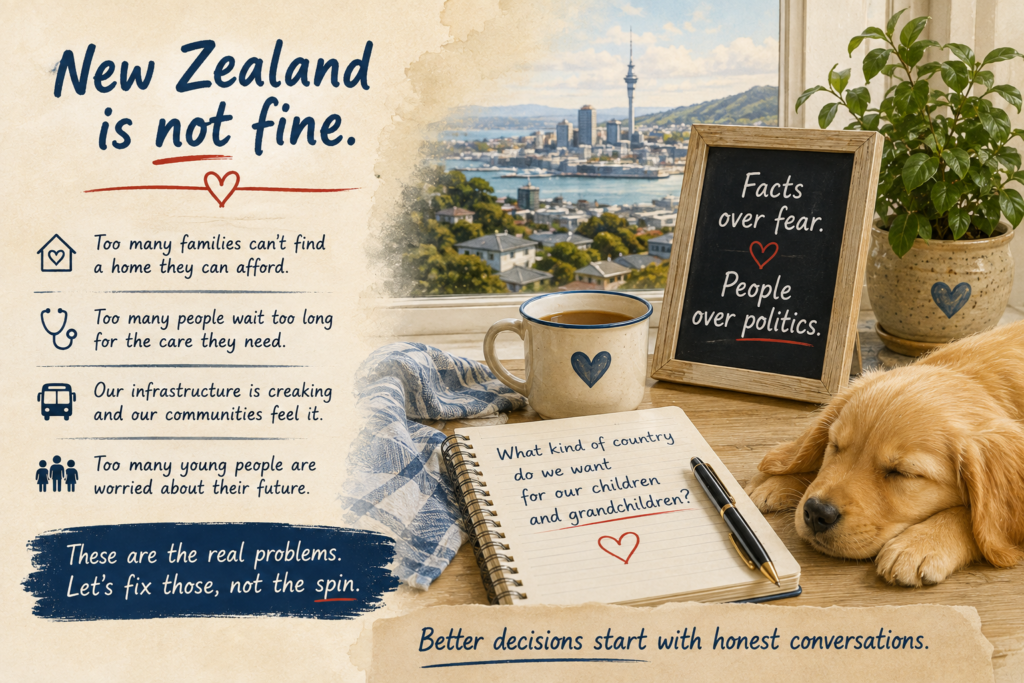
    A quiet New Zealand landscape with the words “New Zealand is not fine. But neither is it beyond fixing,” reflecting on the country’s problems and possibilities.

    We should ask them.

    But there is quite a leap from “New Zealand has serious problems” to “New Zealand is broken.”

    And an even bigger leap from there to “therefore this particular political prescription is the only responsible way forward.”

    That’s the bit that bothers me.

    Because once we convince ourselves that the country is broke, that nothing works and that we simply can’t afford the things we once expected a decent society to provide, all sorts of choices begin to look inevitable.

    Perhaps they aren’t.

    Perhaps some things genuinely do need cutting.

    Perhaps some things desperately need investment.

    Perhaps taxes need changing. Perhaps spending priorities do. Perhaps governments of both left and right need to get considerably better at showing us what we receive for the money they spend.

    Those are arguments worth having.

    But I’d quite like us to have them without first frightening ourselves into believing there is only one possible answer.

    The Facebook post that started all this gave me a tidy explanation for what had gone wrong with New Zealand.

    After doing the homework, I’m rather less certain.

    Some of the figures were real. Some of the problems were real. But a true number does not automatically make the story wrapped around it true.

    Almost everything I looked at turned out to be considerably more complicated than the Facebook version suggested.

    Which, inconveniently, leaves us with questions rather than slogans.

    I think that’s probably a good thing.

    New Zealand is not fine.

    But neither is it beyond fixing.

    So perhaps the question heading into this election isn’t simply who do we blame for getting us here?

    Perhaps it is:

    What kind of New Zealand do we want to build from here — and who do we want it to work for?

    Granny’s going to have a few questions about that.

    An earlier version of this article was published by Scoop. This version has been substantially revised, expanded and given the full Granny treatment.


    Check Granny’s homework

    I don’t expect you to take Granny’s word for it. These are the main sources behind the questions I’ve asked here.

    Stats NZ — Consumers Price Index, June 2026 quarter
    Annual CPI inflation was 4.1% in June 2026. This is the main source behind Granny’s discussion of current price pressures.

    Stats NZ — Labour market statistics, June 2026 quarter
    Unemployment was 5.6% and underutilisation 13.8%, providing the context for Granny’s questions about jobs being harder to find.

    MSD — Benefit Fact Sheets, March 2026
    MSD recorded 12,582 benefit sanctions in the March 2026 quarter, compared with 7,509 in March 2024. Sanctions can involve benefit reduction, suspension or cancellation.

    Companies Office — Latest company statistics
    There were 710 liquidator appointments in the June 2026 quarter, up from 677 in the same quarter of 2025 and 629 in 2024. This is why Granny talks about liquidations remaining elevated rather than treating every company removal as a business failure.

    Treasury — Government financial statements to 30 April 2026
    The source of that attention-grabbing $190.3 billion figure: net core Crown debt was $190.3b, or 42.8% of GDP. Treasury also notes that this measure can fluctuate during the year.

    Reserve Bank — Money creation in New Zealand
    Explains who actually creates money and how the Covid-era Large Scale Asset Purchase programme worked. Under LSAP, the Reserve Bank created settlement cash to buy government bonds — rather more complicated than “Labour turned on the printing presses”.

    Stats NZ — Net migration falls in 2024
    The source behind Granny’s immigration discussion, including the important distinction between migrant arrivals and New Zealand citizens leaving the country.

    HUD — Homelessness Insights
    HUD’s most robust estimate recorded 4,965 people living without shelter at the 2023 Census. Its later evidence indicated that number had increased further, although HUD could not reliably quantify by how much.

    OECD — Economic Surveys: New Zealand 2026
    Useful international context for the debt argument. New Zealand’s comparable debt target remains well below the OECD average, while the OECD also stresses the importance of maintaining fiscal buffers.

    Treasury — 2022 Investment Statement
    Evidence that New Zealand’s infrastructure problems pre-dated the post-Covid migration surge: the report cited an estimated $104b historical infrastructure gap, including $21b associated with the existing housing shortage.

  • But People Aren’t Branches

    But People Aren’t Branches

    Sometimes cutting a tree right back helps it grow again.

    And sometimes governments do need to trim waste, stop doing things that aren’t working and spend our money more carefully.

    But people aren’t branches.

    Who actually feels the cuts?

    “Trimming the fat” may not sound too frightening when you have a regular, well-paid job, a warm house, food in the cupboard and enough tucked away to handle an unpleasant surprise.

    Tightening the belt a notch might be uncomfortable, but it can feel rather responsible—even heroic.

    But what if there is no fat left?

    What if you are already choosing between food and power? What if the children need warm clothes, the rent is overdue and every visit to the supermarket requires advanced mathematics?

    People in that position are too often spoken about as though they are “riff-raff”, “bottom feeders” or simply not trying hard enough.

    Then the jobs disappear.

    The services they rely upon are cut back.

    And they are told the answer is to work harder and stand on their own feet—while the ground beneath those feet is being steadily dug away.

    Government spending doesn’t simply disappear

    National and ACT say lower government spending will help balance the books. Labour says investment in jobs, health, education, infrastructure and public services can help the economy grow.

    Labour still needs to show us exactly how all its sums work. Granny will be checking.

    But government spending does not always disappear into a great Wellington drain.

    What helps an economy grow?

    A person with a job spends money at local businesses.

    A patient treated early may recover and return to work.

    Reliable hospitals, schools, roads, power and public transport help people get to work and help businesses function.

    When people have wages and a little money left after paying the bills, they spend it. Local businesses gain customers. Businesses can employ more people. More people pay tax, and fewer need government assistance.

    Those things help nourish an economy.

    So yes, let’s trim genuine waste.

    But when people are already struggling to survive, further cuts do not encourage growth.

    They starve it.

    Because you cannot cut your way to prosperity if the people expected to create it are cold, hungry, sick or unable to find work.

    Are we trimming waste—or starving the things that help New Zealand flourish?

    Check Granny’s homework

    I don’t expect you to take Granny’s word for it. These are the main sources behind the questions I’ve asked here.

    Labour’s fiscal strategy — balancing the books while investing in growth
    Labour’s own policy sets out its plans to return to surplus, reduce debt and maintain government spending and revenue at about 33% of GDP while investing in jobs, services and economic growth.

    National’s Budget Responsibility Rules — lower spending and no new taxes
    National’s own policy aims to reduce core Crown spending towards 30% of GDP, return to surplus through spending restraint and keep net core Crown debt below 40% over time.

    ACT — a faster return to surplus without new taxes
    ACT says it would balance the books faster by continuing to find savings and creating a smaller government rather than raising additional revenue.

    Interest.co.nz — Labour’s strategy and National’s response
    Independent reporting on Labour’s announcement, including its spending and revenue target, Reserve Bank proposal and Nicola Willis’s claim that the strategy would require substantially more government revenue.

  • If you want to run the country… shouldn’t you front up?

    If you want to run the country… shouldn’t you front up?

    TVNZ has announced a leaders’ debate between Christopher Luxon and Chris Hipkins for 6 October.

    They also invited both leaders to a second debate on 5 November — just two days before the election.

    Luxon declined the second invitation.

    Now, this isn’t really about whether I like Luxon, Hipkins, or anybody else.

    If you’re asking New Zealanders to trust you with running the country, I reckon fronting up, facing scrutiny and answering the awkward questions is part of the job.

    So Granny asks: Why wouldn’t you front up?

    Source: 1News, 20 August 2026 — Luxon vs Hipkins: TVNZ confirms live election Leaders Debate

  • Public Money, Private Healthcare

    Public Money, Private Healthcare

    A meme got Granny wondering where our health dollars are actually going.

    It started, as these things so often do these days, with a meme.

    This one was asking why the Government was giving hundreds of millions of dollars to private healthcare while our public hospitals and health system were struggling.

    Well, that sounded alarming.

    It also turned out not to be quite true.

    I couldn’t find good evidence for the particular $300 million claim being passed around, and there are enough questionable political claims circulating already without Granny adding another one to the pile.

    But the meme had done something useful.

    It made me ask a different question.

    Just how much public money is going into private healthcare — and what are we actually buying with it?

    And that turned out to be much more interesting.

    If my knees hurt, fix my knees!

    Let’s start with the obvious.

    This isn’t entirely hypothetical for Granny. I’m waiting for two knee replacements myself, although there are a few hurdles to get over before anyone lets me near an operating table.

    When that day eventually comes, if there is an operating theatre available at a private hospital down the road, I’m unlikely to demand to see the hospital’s ownership structure before climbing onto the table.

    Fix the knees.

    That is essentially the Government’s argument too.

    In early 2025, the Government announced a $50 million “Elective Boost”, initially aimed at delivering an extra 10,579 procedures by the end of June.

    It worked rather better than expected.

    By the end of June, 16,005 additional procedures had been completed — around 51 percent more than the original target.

    That matters.

    People who had been waiting for treatment got treatment.

    And waiting-time figures have subsequently improved. By the March 2026 quarter, 64.9 percent of patients were receiving elective treatment within four months, compared with 57.3 percent a year earlier.

    We’re still some distance from the Government’s 95 percent target, but improvement is improvement.

    So Granny isn’t going to sit here and claim outsourcing surgery to private hospitals doesn’t work.

    Clearly, it can.

    But here’s where I started scratching my head.

    Where did the extra doctors come from?

    Empty modern operating theatre with surgical table, lights and medical equipment.
    An operating theatre is only capacity if you have the people to staff it. AI-generated image for Granny Asks.

    A private hospital might have an empty operating theatre.

    Wonderful.

    But an operating theatre without a surgeon, anaesthetist, nurses, radiographers, technicians and all the other people needed to make the thing actually function is basically a very expensive room with excellent lighting.

    And New Zealand does not have a large spare health workforce sitting around waiting for someone to ring.

    In fact, quite the opposite.

    Our public and private health systems draw from substantially the same pool of health professionals.

    Health Minister Simeon Brown has acknowledged this himself, saying health workers already “bridge both the public and private hospitals”.

    Which makes me wonder:

    When taxpayers buy an operation from a private hospital, are we creating extra healthcare capacity — or are we sometimes moving the existing capacity from one column to another?

    That’s not quite the same thing.

    There is nothing inherently wrong with doctors working privately. Many specialists have worked across both systems for years.

    But if our public hospitals are short of specialists and nurses while taxpayers simultaneously fund private providers to expand, surely it is reasonable to ask where the people staffing that expansion will come from.

    The Association of Salaried Medical Specialists has reported that between June 2022 and June 2024, specialist employment in public hospitals grew by about 4 percent, while specialist employment in private and other settings grew by about 9.6 percent.

    That doesn’t prove outsourcing caused the difference.

    But it certainly makes the question worth asking.

    And Health NZ’s own advice has warned of the risk of outsourcing drawing staff and expertise from the public system — potentially affecting not only planned care, but the acute services those same specialists help provide.

    So I’m not the only one scratching my head.

    Because this isn’t just about clearing a backlog anymore

    This is the bit that really caught Granny’s attention.

    I had assumed we were buying spare private capacity to help clear the enormous backlog in public healthcare.

    Fair enough.

    Except that isn’t quite where the policy is heading.

    The Government has directed Health New Zealand towards much longer agreements with private healthcare providers — around ten years.

    The argument is that longer contracts give private hospitals certainty. Instead of Health NZ buying operations here and there when waiting lists get out of control, private providers know they will have work coming and can invest in theatres, equipment and staff.

    Again, there is logic in that.

    But ten years isn’t really a temporary solution anymore, is it?

    Health NZ has been working towards longer-term relationships with private providers, and Simeon Brown has been quite open about where he would like this to go.

    His long-term aim, he said in 2025, is for as much planned care as possible to be delivered in partnership with the private sector, leaving public hospitals more focused on acute care.

    Now that deserves a proper public conversation.

    Because we’re no longer simply talking about using an empty private operating theatre to get Granny’s dodgy knees fixed.

    We’re talking about how New Zealand’s health system should be structured.

    So which system are we building?

    This is the question I keep coming back to.

    Imagine we guarantee private hospitals a substantial stream of taxpayer-funded operations for ten years.

    That certainty allows them to invest.

    They can build theatres.

    Buy equipment.

    Recruit specialists and nurses.

    Expand their businesses.

    Nothing particularly sinister about that. It’s exactly what you’d expect them to do.

    But meanwhile, what are we doing to the public hospitals?

    If we invest sufficiently in them too, perhaps the two systems can complement each other beautifully.

    But if public hospitals remain short of staff, struggle to fill vacancies and have ageing infrastructure, while private capacity expands using people drawn from the same limited workforce, something rather different may happen.

    We could gradually create the very dependency that makes outsourcing necessary.

    And once private providers have become essential to delivering publicly funded healthcare, getting that capacity back into the public system would not be quick, simple or cheap.

    That is why I’d like someone to show us more than next year’s waiting-list numbers.

    I’d like to see the long division.

    What does each dollar leave behind?

    Suppose the Government spends $100 million buying operations from private hospitals.

    We get operations.

    Excellent.

    But suppose some or all of that money was instead used to increase capacity in public hospitals.

    Would we get operations and more permanent staff?

    Better theatre utilisation?

    Equipment?

    Training positions?

    Greater capacity for the next decade?

    Perhaps not.

    Perhaps building that public capacity would take too long, cost considerably more, or simply be impossible with the workforce we currently have.

    And somebody waiting in pain today can’t be expected to admire the magnificent public health system we might have built five years from now.

    That’s precisely why this isn’t a simple public-good/private-bad argument.

    I would just quite like to know whether anyone has seriously compared the two options over ten or twenty years.

    Not merely:

    Which option gets the most operations done before the next quarterly report?

    But:

    Which option leaves New Zealand with the strongest health system afterwards?

    Even the surgeons are asking questions

    Training the next generation of surgeons is one of the less obvious consequences of moving planned surgery. Photo: Anna Shvets / Pexels.

    The Royal Australasian College of Surgeons would prefer these operations to be adequately funded and delivered through the public system. But with outsourcing going ahead, it has focused on making sure patients are safe, continuity of care is protected, and future surgeons still get the training they need.

    Trainee surgeons need ordinary operations.

    If increasing numbers of straightforward planned procedures move out of public hospitals, some of the very cases trainees learn from move with them.

    The College successfully pushed for surgical training to be included in private-sector outsourcing contracts, so registrars can retain access to the range of cases they need.

    Good.

    But the fact that this needed addressing tells us something.

    Moving an operation doesn’t just move an operation.

    There are ripples.

    Granny still wants her knees fixed

    None of this means we should stop using private hospitals tomorrow.

    That would be daft.

    There are New Zealanders waiting in pain now, and if unused private capacity can safely get them treated sooner, use it.

    The Government deserves credit where its elective programme has increased the number of people receiving treatment.

    But this is no longer looking like a short-term exercise.

    Private outsourcing is becoming a regular part of planned care. Longer-term contracts are being established, and the Government has made clear that it wants greater partnership with the private sector.

    So perhaps we’ve reached the point where we need to stop talking about this merely as a waiting-list initiative.

    We’re making choices about what New Zealand’s future health system will look like.

    And I’d like us to make those choices deliberately.

    If taxpayers are going to spend billions of dollars on healthcare — and of course we are — then surely the question isn’t simply whether the hospital doing Granny’s knee replacements is publicly or privately owned.

    The question is what happens to that public dollar after Granny hobbles home.

    Did it simply buy an operation?

    Or did it help build the health system that will still be there when her grandchildren need one?

    That’s the question that seems worth asking.

    Even if the meme that started the whole thing got the numbers wrong.


    Check Granny’s Homework

    I don’t expect you to take Granny’s word for it. These are some of the main sources behind the questions I’ve asked here.

    Government elective boost results — 16,005 additional procedures
    The Government’s final results for its first Elective Boost target, including the original 10,579 target and the 16,005 procedures ultimately delivered.

    Health system advice — planned care and the private sector
    Official advice to the Minister of Health examining the benefits and risks of outsourcing, including loss of public-sector staff and expertise, effects on acute care, complex patients and specialist training.

    Auditor-General — equitable access to planned care
    An independent examination of planned care in New Zealand, including waiting times, equity and Health NZ’s use of private providers to increase capacity.

    Royal Australasian College of Surgeons — outsourcing planned surgery
    The surgeons’ position on outsourcing public waiting lists, including patient safety, continuity of care, workforce and protecting opportunities to train future surgeons.

    Health NZ — access to care continuing to improve
    Health NZ’s March 2026 quarter results, including the increase in patients receiving elective treatment within four months from 57.3% to 64.9%.