
It Hadn’t Been Invented Yet.
But Could He Afford a House?
I’ve seen this meme doing the rounds again.
Apparently, Grandpa could afford a house on one wage because he didn’t waste his money on iced lattes, avocado toast, mobile phones, Netflix and takeaway deliveries.
Grandma cooked everything from scratch, made do with what she had, and certainly wasn’t popping out for brunch.
And young people today? Apparently they’re living like rock stars on ordinary wages, then complaining they can’t afford the rent.
The conclusion, delivered with considerable certainty, is:
“It’s not the economy — it’s the lifestyle.”
Really?
Now, I’m a grandma myself. I remember the 1970s rather well, thank you. We didn’t have mobile phones, streaming subscriptions or food delivery apps.
Of course we didn’t. They hadn’t been invented yet.
And Grandma cooked from scratch because there weren’t nearly as many alternatives. Convenience foods, modern appliances and services have changed how households operate.
I remember getting down on my hands and knees to polish my mother’s floors with wax and a brush. And washing day, with one of those big round washing machines and a wringer on top, could take most of Sunday. Things were harder back then.
Do I want to go back to that? Not particularly, thank you.
And let’s not forget something else about Grandma. She cooked, cleaned, raised children, managed the household, mended clothes and somehow kept everything going.
Quite right that she gets some credit for it. But all that unpaid work helped make the one-wage household possible.
Grandpa wasn’t necessarily doing it all on his own.
And plenty of grandmas worked outside the home as well.
So perhaps we shouldn’t congratulate previous generations too enthusiastically for doing without things that weren’t available, or overlook the work that went into keeping those households running.
Times change. That’s rather what time does.
But let’s give Grandpa his due.
He probably worked hard. Grandma stretched the household budget, and they made things last. People often went without things we take for granted today.
I’m not disputing any of that.
What I’m questioning is the suggestion that young people can’t afford homes because they’re not as hardworking or disciplined as their grandparents.
Because there’s something rather important missing from this little sermon.
The price of the house.
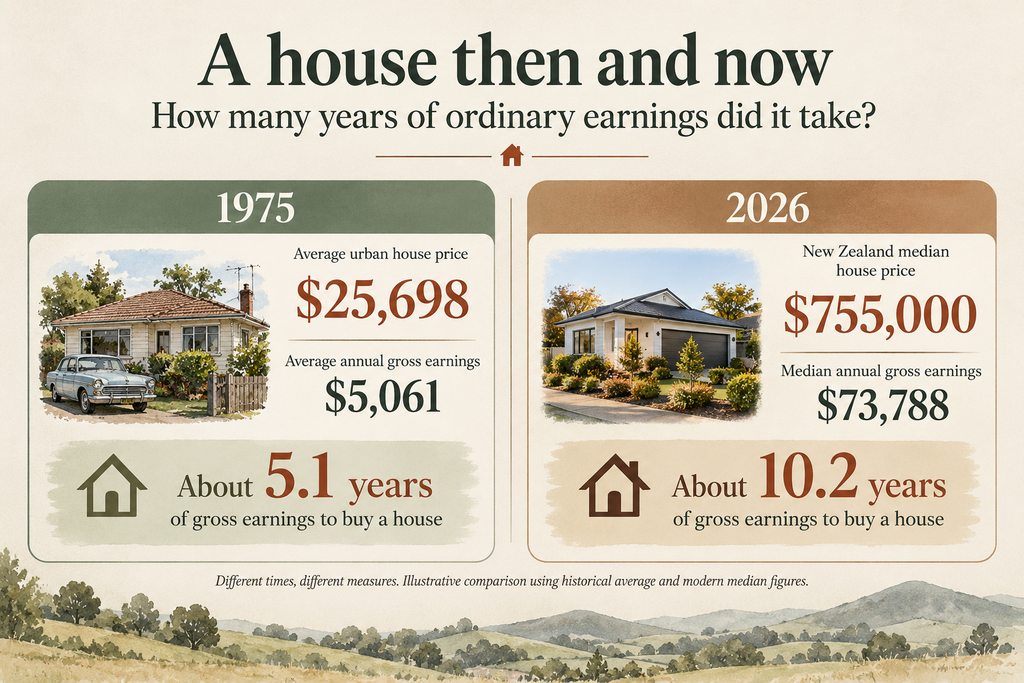
Meet Grandpa Jack.
It’s 1975. Jack is an ordinary New Zealander earning an ordinary wage.
He earns about $5,061 a year, and the average existing urban house costs $25,698. That’s roughly five years of his gross earnings.
Now meet his grandchild, Sam.
It’s 2026. Sam earns the median weekly wage or salary income of $1,419 — about $73,788 a year. The median New Zealand house sells for $755,000. That’s more than ten years of gross earnings.
Different times, different measures, but that’s quite a gap, isn’t it?
And Sam hasn’t bought a single avocado.
Now, before someone reminds me that Grandpa paid higher mortgage interest, yes, he did. In 1975, mortgage interest was around 9.65%, and repayments on an average house, assuming a 20% deposit, could swallow more than 40% of an ordinary gross wage.
Hardly a walk in the park.
But the purchase price relative to earnings was considerably lower, and that matters. It affects the deposit you need, how long you must save for it, and how much you have to borrow. And while you’re saving, you’re probably paying rent.
Funny how that little detail gets overlooked.
But young people have so many luxuries!
Yes, they have things Grandpa never dreamed of. Smartphones, computers, internet connections and all sorts of modern conveniences.
But try applying for a job, running a business, studying, banking or dealing with government departments today without internet access.
A mobile phone isn’t automatically a luxury simply because Grandpa didn’t have one.
And let’s not pretend previous generations never spent money on themselves.
People went to the pub. They smoked. They bought cars, boats and caravans. They went on holidays and enjoyed themselves. Some were careful with money. Some weren’t.
Rather like people today, come to think of it.
Now, let’s talk about wages.
In New Zealand today, someone working 40 hours a week on the adult minimum wage earns $49,816 a year before tax.
The median house price is $755,000.
That’s more than fifteen years of their entire gross earnings.
And before they can even think about buying a house, they need a deposit and a bank willing to lend them the rest.
Of course, that’s assuming they can find a full-time job paying enough to live on in the first place.
Apparently, that’s another small detail we’re supposed to overlook.
So perhaps the problem isn’t simply that young people aren’t saving enough.
Perhaps we should ask whether ordinary wages still provide a realistic pathway to owning an ordinary home.
Personal responsibility? Of course.
I’m all for people living within their means. If you’re spending hundreds of dollars every month on things you don’t need, perhaps you should take another look at your budget. That’s sensible advice, whatever your age.
But there’s a considerable difference between encouraging people to manage their money carefully and blaming an entire generation’s housing difficulties on frivolous spending.
One is common sense.
The other needs evidence.
And the evidence tells us that house prices have risen substantially relative to ordinary earnings. That doesn’t mean Grandpa had it easy, or that every young person is struggling.
It means circumstances have changed.
So, about that avocado toast…
Perhaps Grandpa made his own coffee, drove an old car and lived within his means. Good for him!
But perhaps he also lived in an economy where an ordinary wage could buy considerably more house than it can today.
And perhaps his grandchildren aren’t all irresponsible spendthrifts simply because they have smartphones and occasionally buy themselves a coffee.
Before we lecture them about their lifestyles, shouldn’t we at least acknowledge the difference?
Because you can give up every latte, cancel Netflix and eat baked beans for dinner.
It still doesn’t change the price of the house.
Granny Asks.
Check Granny’s homework
I don’t expect you to take Granny’s word for it. These are the main sources behind the questions I’ve asked here.
Royal Commission on Social Policy (1988) — historical New Zealand house prices and earnings.
REINZ — September 2026 Property Report: New Zealand national median house price, $755,000.
Employment New Zealand — Minimum wage rates from 1 April 2026: $23.95 per hour.
Grandpa Jack and Sam are fictional characters used to illustrate the comparison. The accompanying illustration was created with AI.